

Is your greenhouse running out of space just as demand for your crops begins to grow? Expanding too soon can strain your budget, but waiting too long may limit production and cost you valuable sales. Finding the right time to expand can help you meet demand without putting unnecessary pressure on your resources.
The warning signs can be easy to overlook. Yields may start to dip, disease can spread in overcrowded areas, and harvesting may take longer than it did last season. These issues may seem like isolated problems, but they can indicate that your greenhouse is nearing its capacity as greenhouse production continues to change across the United States.
Recognizing those signals early leaves room to plan carefully. Smart greenhouse planning turns a reactive fix into a measured step forward, one that protects crop quality while opening the door to more volume.
Signs Your Greenhouse Is Reaching Capacity
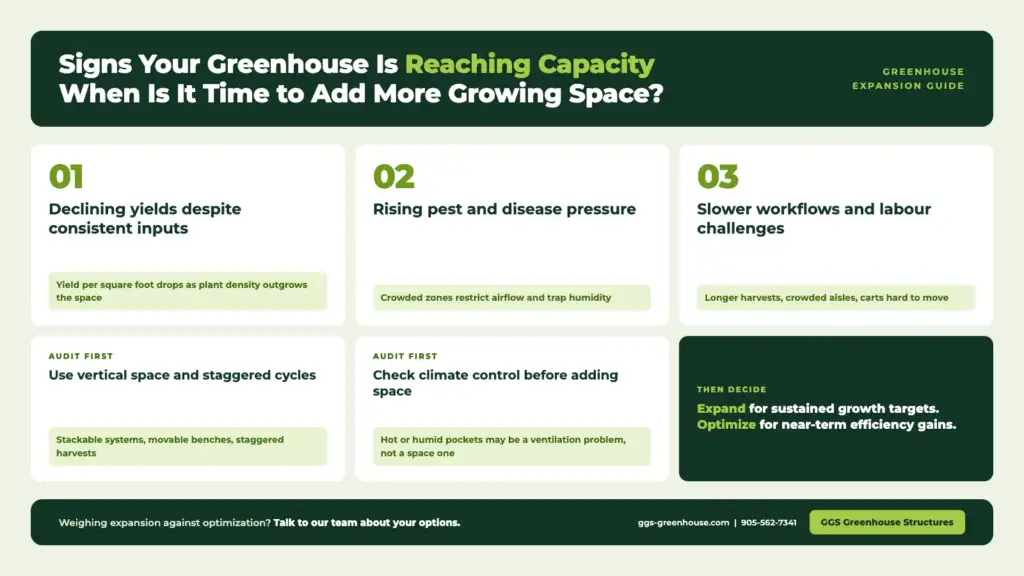
Several signs can indicate that your greenhouse has outgrown its current capacity, from declining yields and rising disease pressure to slower daily operations.
Declining Yields Despite Consistent Inputs
The clearest sign often shows up in the numbers. If yields per square foot decline despite steady inputs, plant density may have outgrown the facility’s ability to maintain suitable growing conditions. The available space may no longer support the crop load.
Rising Pest and Disease Pressure
Overcrowded growing zones restrict airflow and trap humidity, creating conditions that favour pathogens. As a result, pests and diseases can spread more quickly when plants are packed too closely together. Ongoing disease-resistance research at Vineland Research and Innovation Centre reflects the industry’s focus on managing pathogen pressure in commercial growing environments.
Slower Workflows and Labour Challenges
Longer harvest cycles, crowded aisles and difficulty moving carts or equipment can all signal that space is becoming a constraint. When routine tasks such as watering, pruning and disease monitoring take longer than usual, the layout may be working against the team rather than supporting efficient operations.
Evaluating Your Current Growing Space
Before committing to more square footage, growers should audit what they already have. Many find hidden capacity once they look closely.
Use Vertical Space and Staggered Cycles
Wall space, bench height, and stackable systems are frequently underused. Vertical growing systems can add real capacity without a single new bay, and movable benches recover aisle space that otherwise sits idle.
Crop timing offers another lever. Compare overlapping plantings against sequential rotations to see where room to grow already exists. Staggering harvests lets some growers scale output without adding footage, simply by keeping the space productive year-round.
Check Climate Control First
Sometimes a house feels cramped when the real problem is a poor microclimate. Inadequate ventilation, uneven heating, or weak cooling creates hot pockets and stressed plants. Sometimes, the greenhouse isn’t too small; the climate system just isn’t keeping up.
Proper ventilation sizing can help determine whether airflow is adequate. Improving ventilation and temperature control may solve the problem without requiring more growing space.
Deciding Between Adding Space and Optimizing Existing Infrastructure
Once the audit is done, the choice becomes clearer: add space or improve what already stands. Each path carries different costs, timelines, and long-term ceilings.
Lateral additions attach an adjacent structure. Vertical additions raise the roof or add loft systems. A separate building keeps operations distinct. Each option shifts permitting, foundation, and labor needs differently.
Upgrading cooling, ventilation, or irrigation in the current house usually costs less than greenfield expansion, though site conditions can cap how far those upgrades take an operation. A closer look at what real budgets need to account for helps growers compare the two paths honestly instead of guessing at numbers.
|
Factor |
Expansion (New Space) |
Optimization (Existing) |
|
Capital cost |
Higher |
Lower to moderate |
|
Time to productivity |
Longer |
Shorter |
|
Labor impact during work |
Significant |
Minimal to moderate |
|
Future scalability |
High |
Limited by site |
|
Best for |
Sustained growth targets |
Near-term efficiency gains |
Growers chasing steady, long-term growth usually lean toward expansion. Those solving a short-term bottleneck tend to start with optimization and revisit expansion later.
Planning Your Expansion: Key Considerations
A new section succeeds or fails on details set long before the first crop goes in. Three areas deserve close attention.
Foundation and Structural Design
New construction has to align with existing soil conditions, drainage, and load capacity. Freeze-thaw cycles and heavy soils affect footing depth and drainage design in many regions. Custom-engineered greenhouse structures are built around these site realities rather than a generic template, and poor planning here creates problems that surface for years.
Utilities and Systems
Water supply, power, and heating and cooling capacity all need to scale with the added footage. Undersizing any one of them creates a bottleneck that limits the whole facility. Well-matched heating and system integrations carry that load without straining what’s already installed. Drainage deserves the same care, especially in areas with heavy seasonal runoff.
Layout and Workflow
The new section should connect cleanly to propagation, staging, and packing areas. Weak connectivity wastes the very efficiency the expansion promised. A short, direct path for people and product keeps daily work smooth.
Scalability and Future Growth
The best time to plan the next phase is during this one. Designing with future growth in mind costs far less than a second retrofit down the road.
Oversizing water lines, electrical capacity, and drainage now is cheaper than tearing into finished work later. A little extra capacity built into the first phase absorbs the next one without major rework.
A frame design that anticipates growth keeps options open. Some structures allow end walls or bays to be added with minimal fuss when the original layout plans for it. Modular, extensible framing supports each future step, and solid grower knowledge behind the plan makes those decisions easier to get right the first time.
Climate systems should follow the same logic. Heating, cooling, and ventilation architected to scale across sections avoid trouble later. Standalone systems bolted onto one bay tend to run inefficiently once a second area gets tied in. Planning to expand a greenhouse in phases pays off when the core systems are ready for it from day one.
Frequently Asked Questions
Q: How do I know if my greenhouse needs more space or just better airflow?
Start with a walk-through during peak growing conditions. If temperature and humidity stay even across the house but yields still lag, space is likely the constraint. If certain zones run hot or humid while others don’t, ventilation is probably the real issue, and it’s worth fixing before adding square footage.
Q: Can I expand my greenhouse without interrupting current production?
Yes, with careful timing. Many growers phase construction during off-seasons or between harvest cycles. Temporary relocation of active crops, or working one bay at a time, keeps production moving while the new section goes up.
Q: What permits do I need for a greenhouse expansion in Ontario?
Requirements vary by municipality, but expect to need building permits, structural approvals, and electrical inspections at minimum. It’s worth checking with your local building department early, since zoning and setback rules can affect where a new bay can go.
Q: How much should I budget beyond the cost of the structure itself?
Utilities, foundation work, and site prep often add more to the total than growers first expect. Get a full site assessment before locking in a budget so heating, drainage, and power upgrades aren’t a surprise mid-project.
Q: Should I expand one large greenhouse or build a second, separate facility?
It depends on priorities. A single large structure usually lowers per-unit costs and simplifies climate control. Separate facilities can reduce disease spread and support crop diversification, at the cost of extra labor movement between buildings.
Is Your Greenhouse Ready for the Next Stage of Growth?
Expansion timing comes down to reading the signals early. Declining yields, labor bottlenecks, and rising disease pressure all point to a facility at its limit. A thorough audit of existing space should come before any decision to build, and when the numbers say it’s time, a greenhouse expansion planned around real growth targets pays for itself many times over.
Let’s Plan Your Greenhouse Expansion
GGS works with growers to plan greenhouse solutions that reflect their crop requirements, available site conditions, production targets, and long-term business goals. This includes assessing existing infrastructure, identifying opportunities to improve space utilisation, and planning additional growing capacity to support future demand.
If you’re considering an expansion or weighing whether optimization is the better next step, contact our team to discuss your options.